Skip to content
Roger Simmons Roger Simmons

Birds, Words, Pics + TV

  • Home
  • All Posts
    • Orlando Wetlands
    • Merritt Island National Wildlife Refuge
    • Lake Apopka Wildlife Drive
    • Joe Overstreet Road
    • UCF Arboretum
    • Fort DeSoto Park
  • My Bird Catalog
    • All Birds Catalog
    • American Flamingos
    • Bald Eagles
    • Barred Owls
    • Belted Kingfishers
    • Black-and-White Warblers
    • Eastern Bluebirds
    • Florida Scrub-Jays
    • Green Herons
    • Little Blue Herons
    • Northern Parulas
    • Ospreys
    • Reddish Egrets
    • Red-Shouldered Hawks
    • Roseate Spoonbills
    • Sandhill Cranes
    • Whooping Crane
  • Orlando TV News/History
    • Orlando TV Schedules
    • Florida TV History
  • About this Site
Roger Simmons
Roger Simmons

Birds, Words, Pics + TV

These herons are creatures of the night

Roger Simmons, March 6, 2023September 3, 2026

There are several different types of herons, but a couple are harder to find than others. You might have to stay out very late or go out very early to try to see them.

These are the night herons, and there are two kinds in Florida: the Yellow-Crowned Night-Heron and the Black-Crowned Night Heron.

Over the course of the past six weeks, I’ve been able to spot both during my travels.

The first was the Yellow-Crowned Night-Heron, which I saw in the native swamp and rookery area of the St. Augustine Alligator Farm Zoological Park. He/she wasn’t there as an exhibit — this yellow-crowned bird was in an area of the park where herons, egrets, spoonbills and other birds gather to nest, protected from predators by the alligators swimming below the trees.

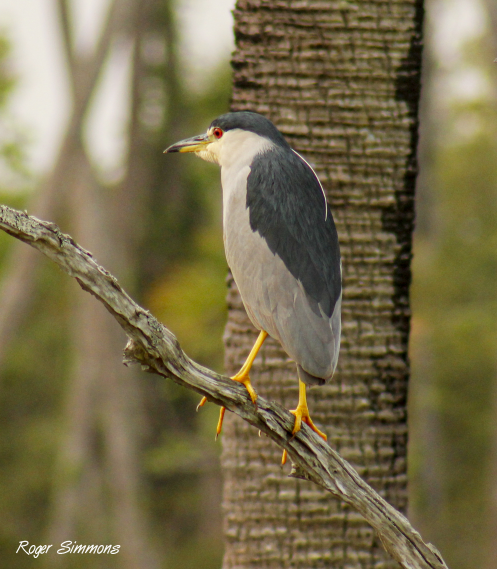
I spotted my first Black-Crowned Night-Heron at the Orlando Wetlands Park a few weeks later. They’re pretty common there, so much so that they have a trail called Night Heron Lane that goes by a pond where you can usually spot one.

What’s the difference between the two night herons?

According to AllAboutBirds.org, “Black-crowned Night-Herons often spend their days perched on tree limbs or concealed among foliage and branches. They forage in the evening and at night, in water, on mudflats, and on land. In flight they fold their head back against their shoulders, almost making the neck disappear.”

As for the Yellow-Crowned Night-Heron, the website says they, “Forage both during the day and at night—in coastal areas the tide can trump the time of day: most foraging occurs from 3 hours before high tide to 3 hours after.”

And another fun fact from AllAboutBirds.org: “This species shows up several times in the fossil record, and the earliest recorded fossil is 2–2.5 million years old (from Sarasota, Florida).”

Black-crowned Night Heron, Lake Apopka Wildlife Drive, November 2025.
Black-crowned Night Heron at sunset, Orlando Wetlands, May 2026.
Juvenile Black-crowned Night Heron, Orlando Wetlands, August 2025.
Juvenile Black-crowned Night Heron, Orlando Wetlands, May 2025.
Black-Crowned Nigh-Heron, Orlando Wetlands, October 2023.
Black-crowned Night Heron, Lake Apopka Wildlife Drive, August 2024.
Black-crowned Night Heron, Orlando Wetlands, March 2025.
This is the first adult Black-Crowned Nigh-Heron I have seen at the Orlando Wetlands in months. I love the red eyes. Taken October 2023.

Share on Social Media
xfacebookredditemail
All Birds Orlando Wetlands Black-Crowned Night-HeronOrlando Wetlands ParkSt. Augustine Alligator Farm and ZooYellow-Crowned Night-Heron

Post navigation

Previous post
Next post

Related Posts

All

Roseates are back, making Orlando Wetlands more colorful

February 17, 2024February 16, 2024

Last year, there were Roseates everywhere at the Wetlands in January and February – but I had not seen nearly as many this year.

Read More
All

Second chance: Shots that didn’t make it before

May 23, 2023June 13, 2023

Fortunately for my Facebook friends, I usually only post a few photos there or here. But there are a lot of photos I still liked that just didn’t make the initial cut for one reason or another.

Read More
All

Burrowing Owl finds a mate in Osceola County

March 25, 2026March 25, 2026

I’ve been checking in regularly on a little Burrowing Owl that’s taken up residence in Osceola County, but I felt sorry that it was all alone

Read More

Latest Posts

  • Ruby-throated Hummingbirds in Central Florida
  • Birds say Florida fall migration season has started
  • Little birds can be big fun to photograph in Florida
  • Surprising summer birding finds in Osceola County
  • Spotting some colorful birds in North Carolina

Top Locations

Orlando Wetlands

Posts about visits to Orlando Wetlands


UCF Arboretum

Posts about visits to UCF Arboretum


Merritt Island

Posts about visits to Merritt Island National Wildlife Refuge


Lake Apopka

Posts about visits to Lake Apopka Wildlife Drive


Fort DeSoto

Posts about visits to Fort DeSoto Park


Galleries

Roger's Favorites

An ever-changing collection of my favorite pictures


American Flamingos

Photos of American Flamingos in Indian River


Belted Kingfishers

Photos of Belted Kingfishers across Central Florida.


Oystercatchers

Pictures of American Oystercatchers at Fort DeSoto Park


Spoonbills

Pictures of Roseate Spoonbills in Central Florida


Whooping Crane

Pictures of one of the last Whooping Cranes in Florida


MORE GALLERIES


Topics

American Flamingo American Kestrel Anhinga Bald Eagles Barn Swallow Belted Kingfisher Black-and-White Warbler Black-Crowned Night-Heron Blue-gray Gnatcatcher Caspian Tern Common Gallinule Common Yellowthroat Digital TV Eastern Bluebird Great Blue Heron Great Egret Green Heron Limpkin Little Blue Heron Northern Cardinal Northern Parula Orlando Wetlands Park Osprey Palm Warbler Prairie Warbler Purple Gallinule Red-bellied Woodpecker Red-shouldered Hawk Red-winged Blackbird Reddish Egret Roseate Spoonbill Sandhill Crane Savannah Sparrow Snail Kite Snowy Egret Tricolored Heron WESH-2 WFTV-9 White Ibis WKCF-18 WKMG-6 WOFL-35 Wood Stork WRDQ-27 Yellow-rumped Warbler

©2025 Roger Simmons | All Rights Reserved